
The heart of dance is joy, a joy brought about because it offers us the means to express ourselves and connect. That seems to be the core philosophy of Tim Lytc and certainly a philosophy I can get behind.
Based in Bristol and London, Lytc is a Hong Kong born dancer, choreography and movement maker who situates their practice in ballet, contemporary, classical Chinese dance and queer cabaret alongside improv and somatic movement. They’ve worked extensively in the South West and London, moving between community engagement projects and artist-led development. After undertaking an MA at Trinity Laban centred on queer inclusive dance practice, they have been a research fellow with Bristol+Bath Creative R&D and worked with organisations including Rhodes Trust, QTI Coalition, Bristol Pride, Queer Space Bristol.
When a mutual friend introduced us, what struck me first about Lytc’s practice was a felt sense of spatiality: the treatment of their environment as a character in and of itself, using it as a means to triangulate between audience and artist.
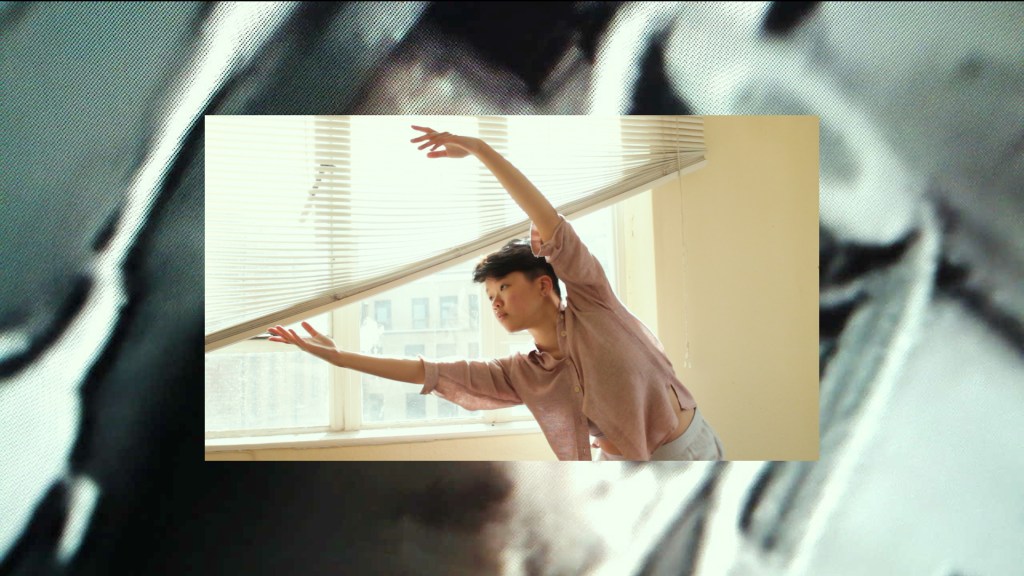
Take Foreign Memories (2021), a collaboration with filmmaker Simone Einfalt and digital artist Harry Willmott capturing the former Gardiner Haskins building in the old soap factory, Soapworks, in Bristol. An improvisational piece, Lytc’s contribution maps how we can use the body to consider memories and histories of abandoned places; how we make them ours through interpretation. About a minute into the film you are presented with Lytc facing a slanted blind in what looks like an old office space, ugly carpet and all. There is a carelessness to the environment, the wonkiness of the metal slats, which one can guess fell after the tension on the material holding them up became too much, or perhaps they was just left like that, a rushed goodbye to the mundane. Still, light rushes in through the window and Lytc tracks the feeling of the room in real time, their arms bestowing a kind of dignity and grandeur to the once forgetful blind. The effect is one of tenderness.
We get its fleeting presence a couple of minutes later: the artist pacing out of frame in a room that looks typically domestic: they brush off their hands absentmindedly, lunch break over, washing done, perhaps, and onto the next task. We watch and we ask: what are the memories that these spaces contain, what new ones can the confer? You settle into contemplation then and bam, the film is done.
Spatiality is a theme picked up in their earlier work, Assembling (2020), made in collaboration with residents of Knowle West, Bristol as part of their creation of Block West: an installation exploring the future of housing. Once again Lytc uses their practice to consider how bodies may use a space: from playful hide and seek, to resting in the sun, to the unexpected arrival of what one can only guess is a mouse. It’s quite beautiful, them, there dappled in the sun as they use the constriction of the wooden blocks to move into a full arabesque, tracing their hand up the material as they go.
Powerful, too, is Lytc’s interpretation of how community members built the space and the collaboration that underpins it. See how they use their body as a tool for physical building materials, but also the curiosity and will that goes into the process of construction. Step by step, inch by inch, just as through the soundtrack we hear testimonies from participants: ‘we need more spaces, we need more innovation, that we’ve come together to create this and there’s been this residency and expression of the joy and the frustration of the process and now what we need is tangible action’. Here is where the art of dance meets social cohesion and power. Movement itself rarely happens in isolation and Lytc understands this: community integral to the experience of dance and its ability to question the structures that keep us separate.
Take their lengthy list of collaborations: poets, musicians, DJs, filmmakers, photographers, visual artists, immersive technologists (MoCap/ VR / AR), and fellow dancers and performers with different training backgrounds. Recent manifestations include work with The Mollusc Dimension on Asians Have Feelings Too (2022), a fantastical short music film that was created in response to Asian hate brought about by COVID-19, and Spectra (2022), a dance short film in collaboration with filmmaker Chris Pugh which explores spectrums of identity, colour and mood inspired by the Pride flag. Spectra stands out for its conviction – it’s an absolute pleasure watching Lytc shift between different states and expressions: rageful fists, defiant wails, sheer joy, culminating in an integration of these modes at the end through light: the rainbow itself.
Still, my favourite of Lytc’s was development footage of Bodily (2021) for Kiota Bristol at Theatre on the Downs. Seeing the artist in front of an audience revealed a level of charisma previously hidden and an ability to feed off the crowd in front of them, less apparent in pre-recorded projects. A solo dance piece investigating their relationship with their body, Bodily infuses its narrative with comedic moments alongside the very real struggle for autonomy and self-respect. We see the artist attempt to control their limbs, placing themself in certain positions and prancing around the stage humming to Tchaikovsky with a forced smile, a reference to their days training in classical ballet and the battle for self-determinism that comes with it.
Knowing Lytc’s classical background and the reputation of ballet being steeped in a world of traditionalism and tribalism, Bodily feels the most personal and triumphant of their works. Here, we see them unveiling more vulnerability: showcasing their strength and flexibility (much to the audience’s delight) and subverting their inherited belief that dancing (and so it follows, bodies) should exist in certain controllable forms.
It seems an apt place to end this review in the same manner that Lytc ends Bodily, with an assertion that ‘there’s no such thing as not being able to dance’. Go further, they say, ‘create your own dances, create your own movement’. What is dance, if not a vehicle for connection, joy, play? It would certainly be a more miserable world without artists like Lytc, where dance was confined to the silos that already exist, refusing to find new answers to the question, how can movement be used to further bring us together?
Eden Szymura is a writer and co-founder of MEDUSA with a background in the visual arts sector. You can read more of her work at edenszymura.com or on her newsletter Yearning.
Cover image: Assembling (2020), photography by Ibi Feher
 MEDUSA